

Overorder by half a cubic metre and you’re out a couple of hundred bucks. Underorder, and the job stops cold while your crew waits for another load. Whether you’re pouring concrete, laying pavers, or filling a garden bed, getting your material estimates right can save serious time and money.
And in today’s market, with material costs climbing and lead times tighter than ever, “just winging it” doesn’t cut it. Estimating your quantities properly keeps your budget on track, cuts down on waste, and helps your job site run smoother.
This guide walks you through how to calculate common materials like concrete, soil, sand, pavers, bricks, and more. We’ll break down formulas, give you real examples, and show you how to avoid common mistakes that lead to costly blowouts.
Whether you’re pouring a patio, shed base, or footings for a retaining wall, calculating concrete right is critical. Underestimate and you’ll hold up the pour. Overestimate and you’re paying for surplus you’ll never use.
Here’s the breakdown for getting it right the first time:
Length × Width × Depth ÷ 1,000 = Cubic Metres (m³)
Example: 3 m × 3 m slab @ 100 mm (0.1 m) thick
→ 3 × 3 × 0.1 = 0.9 ÷ 1,000 = 0.9m³
Then round up by 10–15% to account for over-excavation, uneven base, spillage, and finishing:
0.9 × 1.15 = ~1.035m³ → Order 1.1m³ minimum
Job Type | Recommended Depth | Notes |
Pathways | 75–100 mm | Add mesh for strength |
Slabs (sheds, patios) | 100 mm+ | Reinforce with SL62 mesh |
Driveways | 125–150 mm | For vehicles & load |
Footings | Varies by engineer | Factor trench width/depth |
We’re not just a supplier, we’ll help you double-check your slab dimensions, recommend the right mix, and deliver onsite across Sydney on your schedule. Call us before you pour, we’ll make sure your slab goes down smooth.
Laying pavers or bricks might seem simple, until you’re halfway through the job and realise you’re short a few square metres. Estimating accurately up front saves you extra deliveries, mismatched batches, and return trips.
Here’s how to get your quantities right before a single unit goes down.
Formula: Area (m²) ÷ Coverage Rate = Number of Pavers
Example: 5 m × 4 m patio = 20 m²
Using 400 × 400 mm (0.16 m²) pavers → 20 ÷ 0.16 = 125 pavers
Add 5–10% extra for cuts, breakage, and pattern alignment:
→ 125 × 1.1 = ~138 pavers total
Paver Size | Per m² | Notes |
200 × 100 mm | ~50 | Used for herringbone, running bond |
300 × 300 mm | ~11 | Garden paths, patios |
400 × 400 mm | ~6.25 | Large-format, modern finishes |
500 × 500 mm | ~4 | Clean, minimalist look |
Remember: joints and spacing affect the final layout. Always check your pattern plan before ordering.
Formula: Wall Area (Height × Length) × Bricks per m² = Total Bricks Needed
Example: 2.4 m × 4 m wall = 9.6 m²
Standard bricks (76 mm height) = ~50 per m²
→ 9.6 × 50 = 480 bricks
Add 10% extra for cuts, waste, and breakage:
→ 480 × 1.1 = ~530 bricks
Whether you’re topping up garden beds, backfilling trenches, or bedding pavers, the one thing you shouldn’t do is guesstimate how much sand or soil you’ll need. It’s too easy to fall short or end up with half a cubic metre sitting in your driveway for three months.
Here’s how to calculate it with precision and avoid the back-and-forth.
Length × Width × Depth ÷ 1,000 = Cubic Metres (m³)
Example: 5 m × 2 m garden bed @ 400 mm (0.4 m) deep
5 × 2 × 0.4 = 4.0 ÷ 1,000 = 4.0m³ needed
Add 10% extra to account for settling, compaction, and surface variation:
→ ~4.4m³ total
We know exactly how much fits in each truck, how your site access works, and how to get bulk material dropped right where you need it. Call us to quote your mix and book a smooth delivery anywhere across Sydney.
From prepping driveways and laying pavers to filling trenches and adding decorative finishes like gravel, road base, and crushed stone are essential. But they’re heavier, denser, and trickier to estimate than most materials.
Order too little, and you risk an uneven base. Order too much, and you’re stuck with a pile of rock taking up your parking spot. Let’s get your numbers dialed in properly.
Length × Width × Depth ÷ 1,000 = Cubic Metres (m³)
→ Then multiply by material density to get tonnes
Example: 10 m × 2.5 m driveway @ 100 mm (0.1 m) depth
10 × 2.5 × 0.1 = 2.5m³
Now multiply by density:
Material | Use Case | Density (approx) |
Road Base | Paving sub-base, driveways | 2.0 t/m³ |
Blue Metal 20mm | Drainage, trenching | 1.5–1.7 t/m³ |
Crushed Limestone | Decorative & compactable base | 1.6–1.8 t/m³ |
Decorative Gravels | Finishing touch for gardens | 1.4–1.6 t/m³ |
Whether you’re filling 30 m of trench or laying a crushed stone base for pavers, we’ve got the right rock and the right truck. Let us help you figure out the tonnes, schedule delivery, and get your base sorted without the guesswork.

Even seasoned tradies get caught out by bad estimates. For DIYers, it can be worse; what starts as a weekend job turns into a three-week mess because the wrong quantity shows up or the wrong material gets dumped.
Here’s a list of common pitfalls and how to sidestep them like a pro.
Always allow 5–15% extra, depending on material type and job:
Material | Recommended Extra |
Concrete | 10–15% (spills, uneven base) |
Soil/Sand | 10% (settling, compaction) |
Bricks/Pavers | 5–10% (cuts, chips) |
Gravel | 10% (compaction, spread margin) |
Why it matters: You’ll rarely get a perfect site or pour. Playing it too tight risks delays and double-handling.
It’s not just about area, it’s about depth.
Estimate based on depth after compaction, not before.
Example: 100mm of gravel will compact to ~80mm. If you don’t allow for that, you’ll come up short.
Cubic metres, square metres, linear metres, get your units straight. Don’t calculate in bags unless you’ve triple-checked the conversion.
Why it matters: 20kg bags add up fast. A 1m³ order in bags = ~50 bags of soil or 80 bags of concrete mix. That’s a lot of lifting when bulk delivery could’ve done the job in one go.
Soft ground? Sloped surface? Tight access for the truck? Any of these can change how much you’ll need or whether a full load can be dropped where you want it.
We’ve been around for a while and have seen it all: DIY backyard builds, school upgrades, multi-trade sites. Give us your dimensions and job type, and we’ll help you validate the volume, material choice, and delivery logistics before you buy.
Getting your estimates right is just the start. The real value? Having a local supplier that doesn’t just drop a load and disappear.
At MBS, we’ve been helping Sydney tradies, landscapers, and DIYers get it right since 1983. We don’t just sell materials, we help you plan your job, quote it properly, and make sure the right amount lands on site, on time.
Here’s what you can expect when you work with us:
We may not have a flashy online calculator (yet), but what we do have is better: decades of experience, local knowledge, and honest advice. If you’ve got measurements and a goal, we’ll help you hit it.
“Got a job coming up? Give us a ring. We’ll help you get your numbers sorted and your gear delivered without the drama.”
Whether you’re pouring concrete, laying pavers, or landscaping a backyard, the difference between a smooth job and a budget blowout often comes down to your material estimates. Get them right, and everything flows. Get them wrong, and you’re losing time, money, and probably patience too.
This guide gave you the key formulas, practical tips, and local trade logic to work it out. But if you’d rather skip the math or just want a second opinion before you place that order, we’re right here in NSW, ready to help.
We’ll check your measurements, help you choose the right mix or material, and make sure it gets to the site when you need it. No guesswork. No over-ordering. No delays.
Ready to get started? Give MBS a call and let’s get your materials sorted quickly, accurately, and ready to roll.
As a trade partner at MBS, your business has access to our world of landscaping and building supplies. Sign up now and be the first to know about any news, specials or events happening.

A medium sized truck with a 4.5 tonne payload. Excellent for sites that can take loose/bulk material.
Height: 2.4m | Width: 2.4m | Tipper Length: 3.83m | Overall Length: 5.87m | Payload: 4.7 tonne
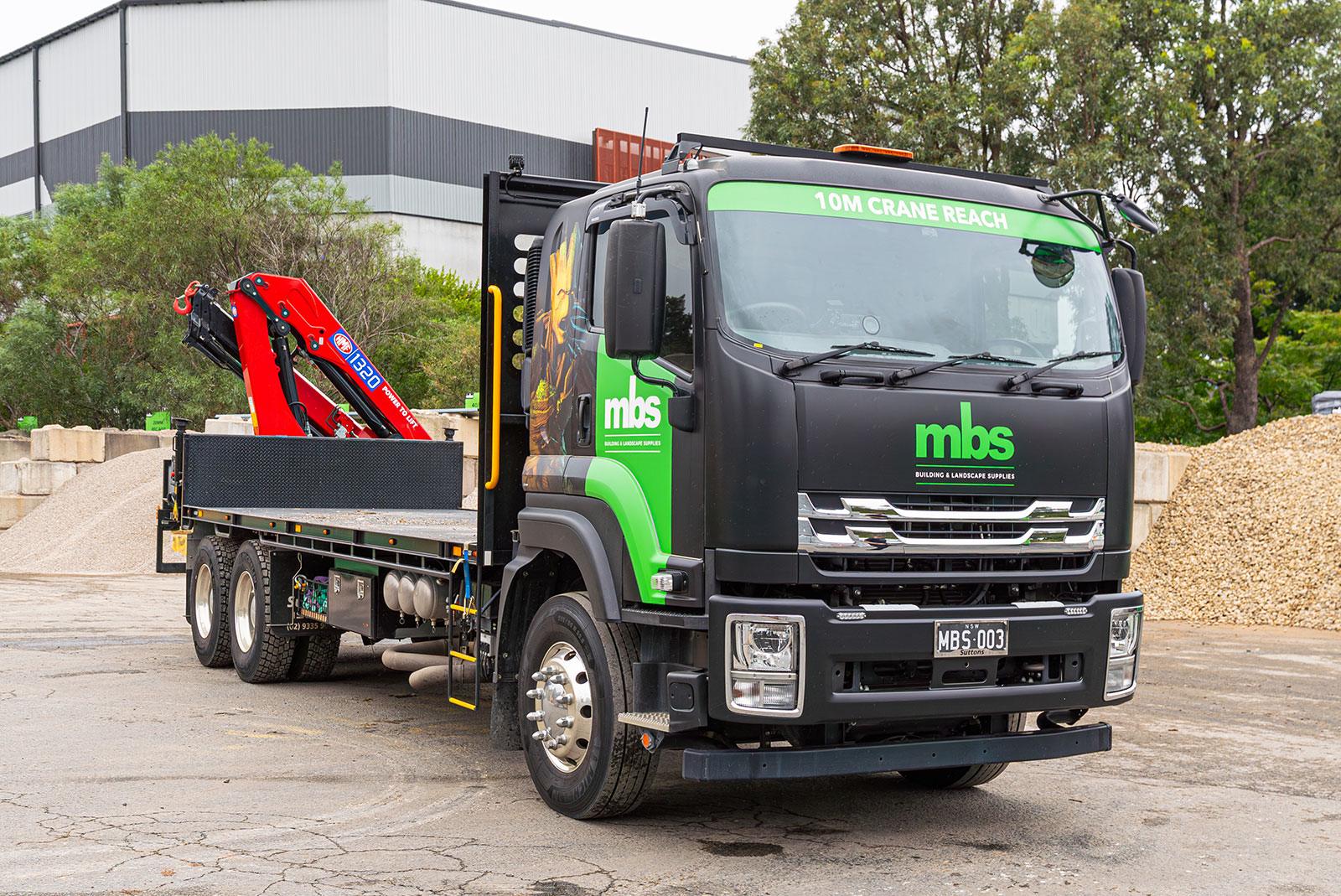
This truck has a 10.8T payload with a crane cable of reaching 10 metres at 1 tonne
Height: 3.4m | Width: 2.4m | Tray Length: 6.5m | Overall Length: 9.95m | Payload: 10.8 tonne
*Operating width includes outriggers fully extended to one side
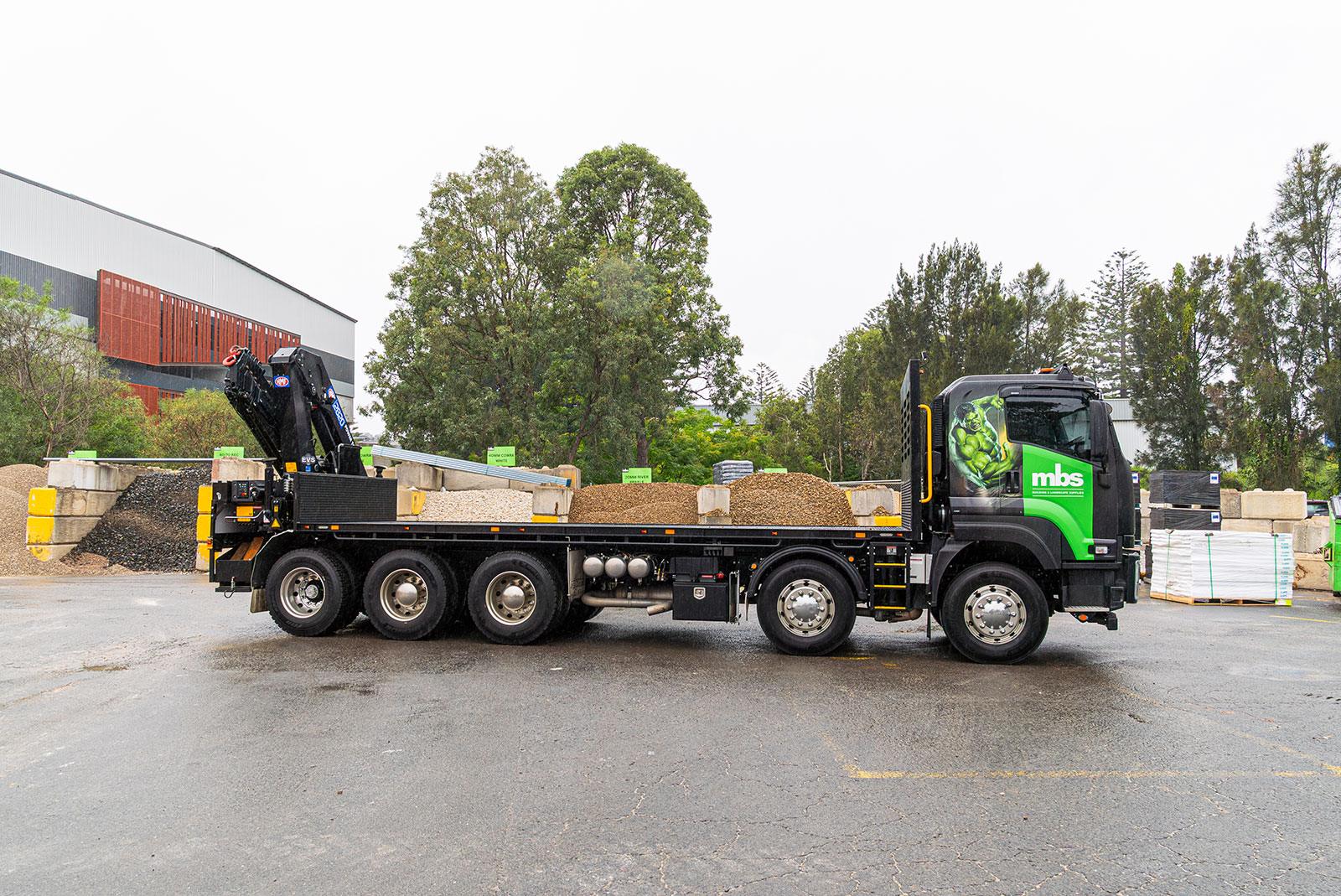
Height: 3.5m | Width 2.4m | Operating Width: 5.5m | Tray Length: 6.98m | Overall Length: 10.5m | Payload: 14.8 Tonne | Crane: 17m @ 1 Tonne
*Operating width includes outriggers fully extended to one side

The Concrete Butler is a volumetric concrete mixer which produces concrete on demand & precisely tailored to your requirements. Its perfect for the small scale pours of 0.5m3 – 6m3. This unique systems allows you to pay for exactly what you use, eliminating any waste and unnecessary expenses.
Length: 10.6m | Height: 3.5m | Width: 2.4m

We have a fleet of modern Truck & Dog tipper trucks with payloads up to 40 tonnes. Our bulk transport division is perfect for your bulk loads or for your long distance haulage requirements. Our fleet are Mass & Fatigue accredited with the NHVR. NHVR is Australia’s regulator for all heavy vehicles.

Our 10 wheeler table top is great for those job sites where you need max playload and efficiency with your palletised goods. Block, bricks and cement can be delivered with easy and material can either be craned or forklifted on site. A crane or forklift must be present on site to assist with unloading.
Pallet Spaces: 10 | Overall length: 10.6m | Payload: 18 tonne | Height: 3.7m | Width: 2.5m |Tray length: 7.3m

This truck has a 12.2 ton payload and a 8 meter rear mounted crane. This truck can also pull a dog trailer increasing payload to a whopping 24 ton and offering unrivalled value for your delivery dollar. (Only capable of delivering bulka bags or palletised products)
Truck: Height: 2.9m Width 2.4m Tray Length: 4m Overall Length 7.4m Payload: 12.2 Tonne Crane: 8m @ 1 Tonne
Trailer: Height: 2.9m Width 2.4m Tray Length: 5.9m Overall Length 8.5m Payload: 13.7 Tonne
Total: Overall Length 17m Payload 25.9 Tonne

MBS crane hire offers the ability to reach 31 meters with the flexibility of a table top truck allowing for transportation of goods up to 6 meters in length. This crane truck is a modern Volvo European truck with a highly capable and technologically advanced rear mounted 31 meter reach Palfinger Crane. It’s a recipe for excellent onsite solutions and one that possess the ability to reach further onsite, winch, transport and ultimately offer unparalleled convenience.
Height: 4.3m | Width: 2.4m | Operating Width: 6m | Tray Length: 6m | Overall Length: 11.5m | Payload: 6.5 tonne | Crane: 31m @ 500kg
*Operating width includes outriggers fully extended to one side

Offering a 11.2 ton payload and a massive 21 meter reach at one tonne this truck offers unrivalled onsite logistics. This truck can crane our materials onsite or be hired for onsite crane work making your onsite logistics a simple phone call. (Only capable of delivering bulka bags or palletised products)
Height: 3.5m | Width 2.4m | Operating Width: 6m* | Tray Length: 6.5m | Overall Length: 11.5m | Payload: 11 Tonne | Crane: 21m @ 1 Tonne
*Operating width includes outriggers fully extended to one side

This 17 metre rear mounted crane truck can pretty much do it all. Offering a whopping 12.7 ton payload and the ability to crane 1 tonne at 17 metres this truck is perfect for onsite crane work or lifting material to those otherwise out of reach places. (Only capable of delivering bulka bags or palletised products)
Height: 3.5m | Width 2.4m | Operating Width: 5.5m | Tray Length: 6.5m | Overall Length: 10.2m | Payload: 12 Tonne | Crane: 17m @ 1 Tonne
*Operating width includes outriggers fully extended to one side

This truck has a 12.2 ton payload and a 8 meter rear mounted crane. This crane truck can also pull a dog trailer increasing payload to a whopping 24 ton and offering unrivalled value for your delivery dollar. (Only capable of delivering bulka bags or palletised products)
Height: 2.9m | Width 2.4m | Tray Length: 4m | Overall Length: 7.4m | Payload: 12.2 Tonne | Crane: 8m @ 1 Tonne
*Operating width includes outriggers fully extended to one side

This little truck offers a 5 meter rear mounted crane and excellent onsite logistics whilst offering a 6.6 ton payload. (Only capable of delivering bulka bags or palletised products)
Height: 2.9m | Width 2.4m | Tray Length: 4m | Overall Length: 7.4m | Payload: 7 Tonne | Crane: 5.5m @ 1 Tonne

Code name “Spiderman” this is one of the most versatile trucks in our fleet, the 3m crane/tipper combo can deliver loose, bulka bag or even palletised material on-site, and placed on the ground for your convenience. Being the smallest of our crane trucks, it has the ability of getting into those tighter access areas where other larger crane truck cannot.
Height: 3.0m | Width 2.4m | Tray Length Internal: 3.5m | Overall Length: 6.3m | Payload: 5 Tonne Crane: 3.5m@ 1 Tonne

A medium sized truck with a 5 ton payload. Excellent for sites that can take loose/bulk material.
Height: 3.1m | Width 2.85m | Tray Length: 4.1m | Overall Length 6.6m

Small and compact this little truck has a 3 ton payload and is excellent for those tight jobs where access is limited.
Height: 2.1m | Width 2.0m | Tray Length: 3.08m | Overall Length 4.8m | Tipping Height: 4.3m | Payload: 3 Tonne